
Assassination of Archduke Franz Ferdinand
Archduke Franz Ferdinand was next in line to rule Austria-Hungary. While visiting Sarajevo, he and his wife Sophie were shot by Gavrilo Princip, a 19-year-old Bosnian Serb tied to a secret group called the Black Hand that wanted Bosnia free from Austria-Hungary. Austria-Hungary blamed Serbia for the attack. This one killing became the spark that started World War I.

Alliances Pull Europe Into War
Austria-Hungary declared war on Serbia on July 28, 1914. Because of the alliance system, the fight spread fast: Russia backed Serbia, and Germany backed Austria-Hungary and declared war on Russia and France. When Germany marched through neutral Belgium to reach France, Britain declared war on August 4. In about one week, a local conflict turned into a war between the Allies (France, Britain and Russia) and the Central Powers (Germany and Austria-Hungary).

First Battle of the Marne
Germany's plan, called the Schlieffen Plan, was to defeat France quickly and then turn east to fight Russia. By September 1914 the German army had come within about 30 miles of Paris. French and British troops stopped them at the Marne River, and some French soldiers were even rushed to the front in Paris taxicabs. The victory saved Paris, but it also ended any hope that the war would be short.

Trench Warfare
After the Marne, both sides dug trenches that eventually ran from the North Sea all the way to Switzerland. Soldiers lived with mud, rats, lice and disease, and the deadly ground between the two sides was called "No Man's Land." New weapons like machine guns, heavy artillery and poison gas, which Germany first used on a large scale at Ypres in 1915, made every attack extremely costly. For almost four years the front barely moved, so the war became a war of attrition where each side tried to wear the other down.

Sinking of the Lusitania
The Lusitania was a British passenger ship sailing from New York to Liverpool. A German U-boat torpedoed it off the coast of Ireland, and it sank in about 18 minutes. Nearly 1,200 people died, including 128 Americans. The attack turned many Americans against Germany and pushed Germany to limit its submarine attacks for a while.

Battle of the Somme
The Somme was a huge British and French attack meant to break through German lines and take pressure off the French fighting at Verdun. On the first day alone, the British had about 57,000 casualties, the worst single day in British military history. Tanks were used in battle for the first time here in September 1916. After almost five months the Allies gained only about six miles, and more than a million soldiers on both sides were killed or wounded.

Zimmermann Telegram and the U.S. Enters the War
In early 1917 Germany went back to unrestricted submarine warfare, sinking ships without warning, including American ones. Britain also intercepted and decoded the Zimmermann Telegram, a secret German message offering to help Mexico get back Texas, New Mexico and Arizona if it joined a war against the United States. When the message was published, Americans were furious. President Woodrow Wilson asked Congress to declare war, and the U.S. officially entered the war on April 6, 1917.
 The coded Zimmermann Telegram as received by Germany's ambassador to Mexico · National Archives, public domain
Russia Leaves the War
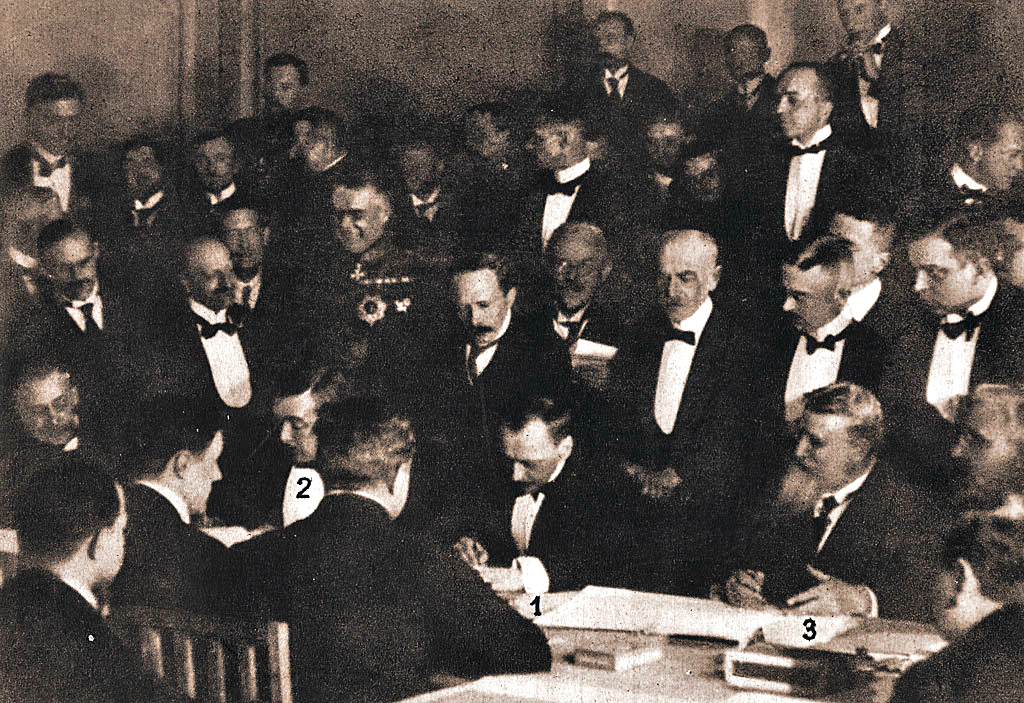
Russia had lost millions of soldiers and its people were starving, which led to revolution in 1917. In March, Czar Nicholas II gave up his throne, and in November Vladimir Lenin and the Bolsheviks took power, promising "peace, land and bread." On March 3, 1918, Russia signed the Treaty of Brest-Litovsk with Germany and gave up a huge amount of land. With Russia out, Germany could move its troops west to fight on the Western Front.

The Armistice
In the spring of 1918 Germany launched one last huge offensive, but fresh American troops helped the Allies stop it and push back. Germany's allies quit one by one, and Kaiser Wilhelm II gave up his throne. At 11 a.m. on November 11, 1918, an armistice, or ceasefire, went into effect and the fighting finally ended. By then an estimated 8.5 to 10 million soldiers had died.

Treaty of Versailles
The peace treaty was written mostly by the "Big Four": Woodrow Wilson of the U.S., David Lloyd George of Britain, Georges Clemenceau of France and Vittorio Orlando of Italy. It was signed in the Hall of Mirrors on June 28, 1919, exactly five years after the assassination in Sarajevo. Germany had to accept blame for the war, pay reparations, give up land and colonies, and shrink its military. The treaty also created the League of Nations, but many Germans were angry about it, and that anger helped lead to World War II.